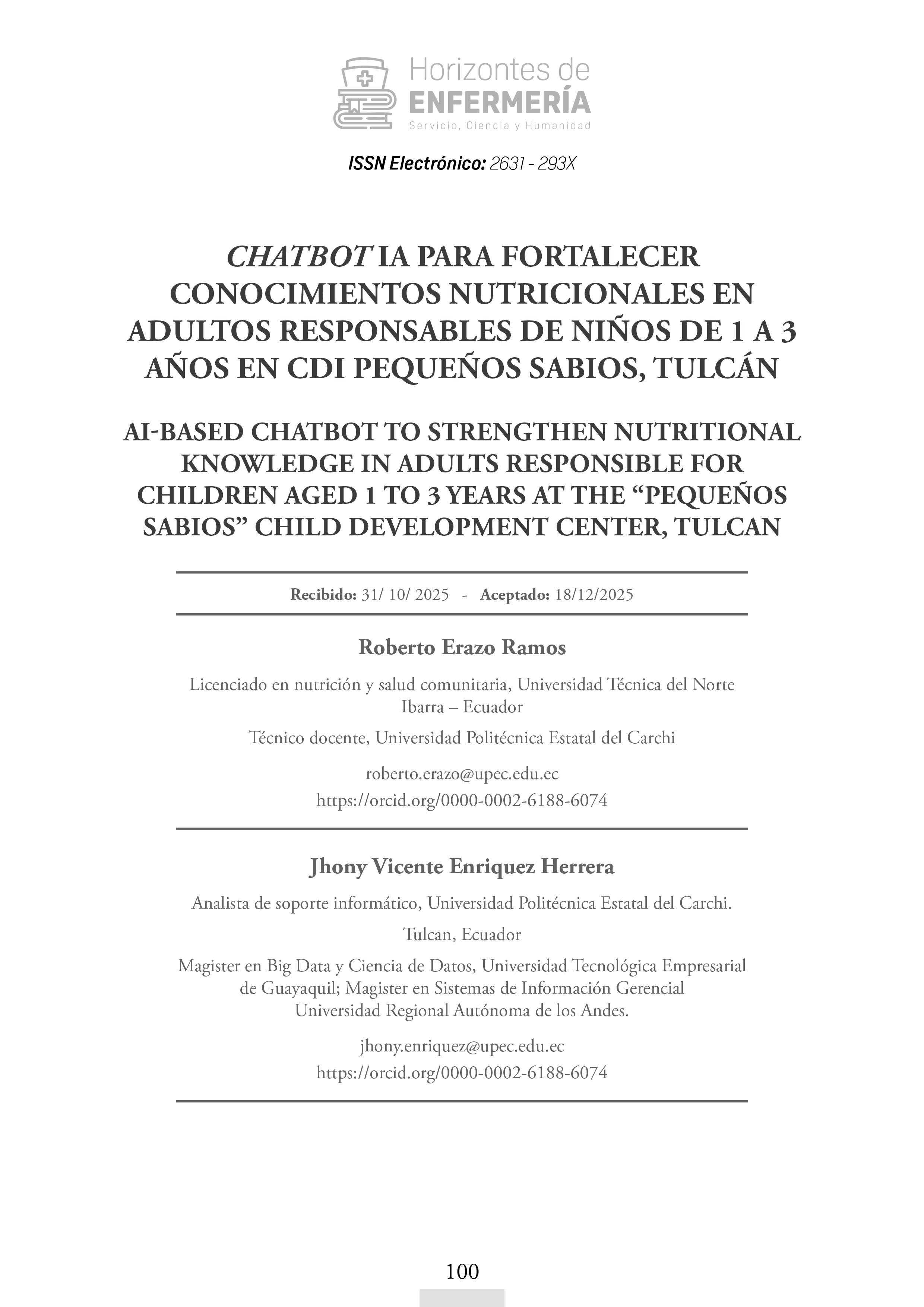
Ai-based chatbot to strengthen nutritional knowledge in adults responsible for children aged 1 to 3 years at the “Pequeños Sabios” Child Development Center, Tulcan
DOI:
https://doi.org/10.32645/13906984.1437Keywords:
Educational chatbot, artificial intelligence, nutritional education, early childhood, caregivers, and parentsAbstract
The purpose of this research was to develop and implement an artificial intelligence-based educational chatbot, named “ANIA,” to reinforce nutritional learning among parents, teachers, and caregivers of children aged 1 to 3 years at the “Pequeños Sabios” Child Development Center in the city of Tulcán. The study employed a mixed-methods approach: applied, descriptive, and explanatory. Quantitative and qualitative techniques were employed, involving a combination of surveys and semi-structured interviews to assess participants’ knowledge, practices, and perceptions of child nutrition, as well as their level of technological acceptance. Based on the diagnosis, the chatbot was designed using the Dialogflow ES platform, with training grounded in specialized content on healthy eating, nutritional status, hydration, physical activity, and hygiene, which was hosted on the website developed for this research. The final prototype, “ANIA,” was evaluated by a group of 18 people through an initial pre-test and a final post-test. The results show an average 8% improvement in nutritional knowledge, with a higher number of correct answers—reaching 100% on the post-test—and over 90% acceptability in terms of utility, accessibility, and educational relevance. The results allow us to conclude that ANIA is an innovative, accessible, and cost-effective educational tool that facilitates access to nutritional information, strengthens teamwork between families and teachers, and helps prevent malnutrition in early childhood.
Downloads
References
Aulia, S., Putri, N., y Rahman, A. (2024). Design and evaluation of a chatbot to prevent stunting through maternal nutrition education in Indonesia. Journal of Nutrition Education and Behavior, 56(2), 210-219. https://doi.org/10.1016/j.jneb.2024.01.005
Black, R. E., Victora, C. G., Walker, S. P., Bhutta, Z. A., Christian, P., de Onis, M., Ezzati, M., Grantham-McGregor, S., Katz, J., Martorell, R., y Uauy, R. (2013). Maternal and child undernutrition and overweight in low-income and middle-income countries. The Lancet, 382(9890), 427-451. https://doi.org/10.1016/S0140-6736(13)60937-X
Bowlby, J. (1982). Attachment and loss: Attachment (2a. ed.). Basic Books.
Bronfenbrenner, U. (1979). The ecology of human development. Experiments by nature and design. Harvard University Press.
Chen, L., Lin, C., y Wang, H. (2023). Gamified chatbot for parental nutrition education: Improving attitudes and knowledge toward child feeding. Computers in Human Behavior Reports, 9, 100255. https://doi.org/10.1016/j.chbr.2023.100255
Coordinación Zonal 1 de Salud. (2024). Reporte de Desnutrición Infantil en la Zona 1 de Salud del Ecuador. Coordinación Zonal 1 de Salud.
Elmasri, M., Mazumdar, A., y Bhatia, M. (2022). Chatbot-assisted nutrition education for South Asian migrant youth: A pilot study. Frontiers in Digital Health, 4, 894315. https://doi.org/10.3389/fdgth.2022.894315
Fondo de las Naciones Unidas para la Infancia. (s.f.). Desnutrición crónica infantil en Ecuador. Unicef. https://www.unicef.org/ecuador
Fondo de las Naciones Unidas para la Infancia. (2021). Los primeros 1000 días: Una oportunidad de oro para el desarrollo del niño. Unicef.
Hernández-Sampieri, R., & Mendoza, C. P. (2018). Metodología de la investigación: las rutas cuantitativa, cualitativa y mixta. McGraw-Hill Education.
Laranjo, L., Dunn, A. G., Tong, H. L., Kocaballi, A. B., Chen, J., Bashir, R., Surian, D., Gallego, B., Magrabi, F., Lau, A. Y. S., y Coiera, E. (2018). Conversational agents in healthcare: a systematic review. Journal of the American Medical Informatics Association, 25(9), 1248-1258. https://doi.org/ 10.1093/jamia/ocy072
Lin, Y. C., Chen, C. H., y Hsu, S. Y. (2022). Integrating a gamified chatbot with OMO learning to enhance parental nutrition knowledge: a pilot study in Taiwan. Interactive Learning Environments, 30(8), 1550-1564. https://doi.org/10.1080/10494820.2022.2031449
Maher, C. A., Davis, C. R., Curtis, R. G., Short, C. E., Murphy, K. J., y Lewis, L. K. (2023). Chatbots and conversational agents in health promotion: a systematic review and meta-analysis. Preventive Medicine, 175, 107682. https://doi.org/10.1016/j.ypmed.2023.107682
Mendoza, L., Cevallos, D., y Rojas, A. (s.f.). Encuesta Nacional sobre Desnutrición Infantil en Ecuador (ENDI). Ministerio de Salud Pública del Ecuador.
Narain, K., Brown, T., y Smith, L. (2023). Perceptions of chatbot-delivered nutrition information among WIC participants: a qualitative study. Public Health Nutrition, 26(5), 1225-1233. https://doi.org/10.1017/S136898002300001X
Organización de las Naciones Unidas para la Alimentación y la Agricultura. (2020). Guías alimentarias para los niños menores de cinco años. FAO.
Organización Mundial de la Salud . (2021). Guías alimentarias para niños menores de cinco años. OMS.
Patton, M. Q. (2015). Qualitative research and evaluation methods (4a. ed.). SAGE Publications.
Samoita, N. (2023). Impact of AI-based chatbots on nutritional knowledge and healthy habits: A randomized controlled trial in Kenya. BMC Public Health, 23, 1124. https://doi.org/10.1186/s12889-023-1124-0
Shonkoff, J. P., y Garner, A. S. (2012). The lifelong effects of early childhood adversity and toxic stress. Pediatrics, 129(1), e232–e246.
Winkler, R., y Söllner, M. (2018). Unleashing the potential of chatbots in education: A state-of-the-art analysis. Proceedings of the European Conference on Information Systems (ECIS), 1-15. https://doi.org/10.5465/AMBPP.2018.15903abstract
Yin, R. K. (2018). Case study research and applications: Design and methods (6a. ed.). SAGE Publications.
Downloads
Published
Issue
Section
License
Copyright (c) 2026 Roberto Erazo Ramos, Jhony Vicente Enriquez Herrera

This work is licensed under a Creative Commons Attribution-NonCommercial-ShareAlike 4.0 International License.
El autor mantiene los derechos morales e intelectuales de su obra, autorizando a la editoruial de la revista revista Horizontes de Enfermería ladifusión y la divulgación de su contenido con fines estrictamente académicos y de investigación, sin fines de lucro.