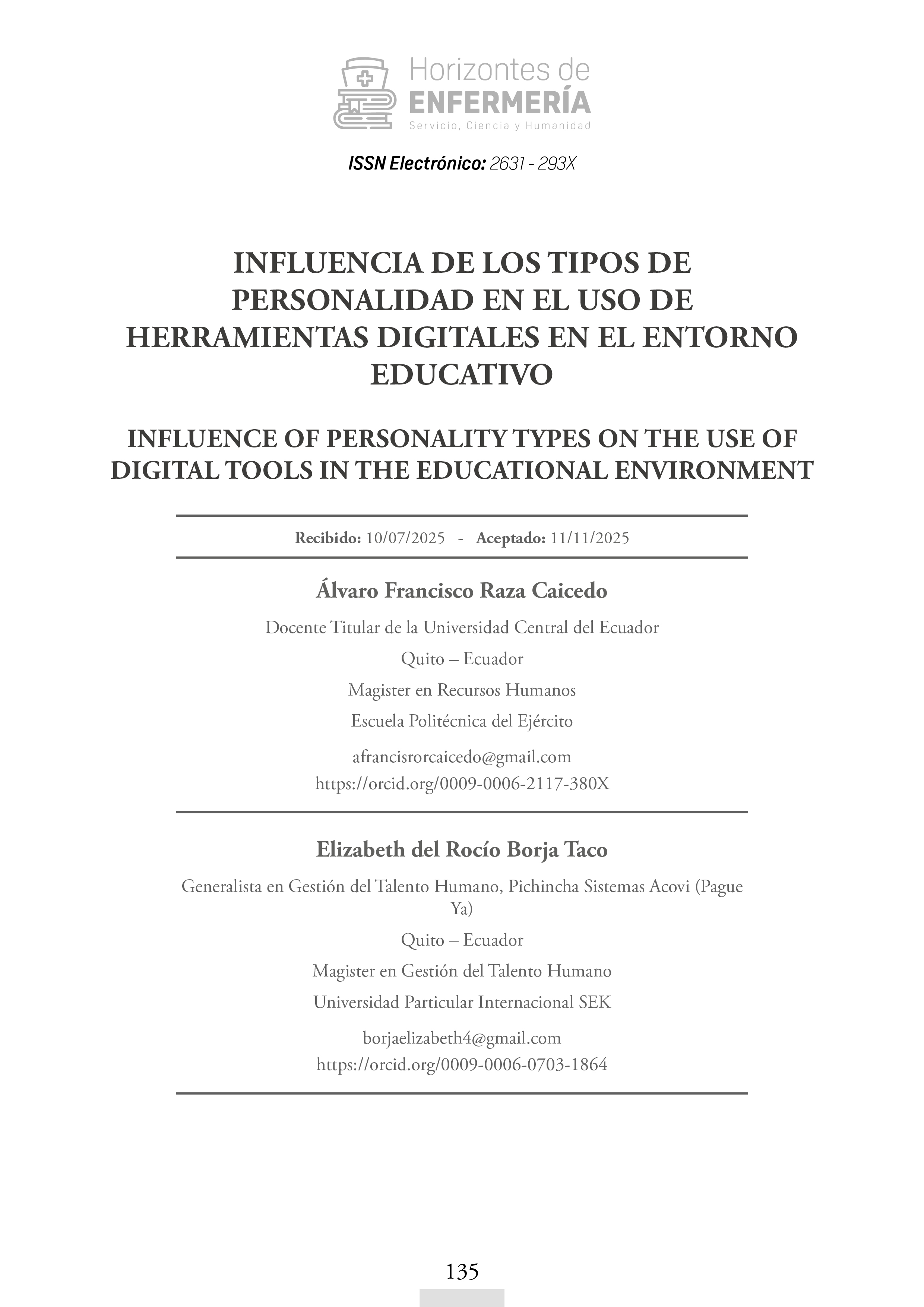
Influence of personality types on the use of digital tools in the educational environment.
DOI:
https://doi.org/10.32645/13906984.1439Keywords:
Teacher personality, technology adoption, digital competenceAbstract
Research among teachers from three secondary schools in the city of Quito, Ecuador, found that different personality types are determining factors in the use of digital tools for educational tasks. Using an intentional sample, the approach to the investigative process was mixed with a descriptive-correlational design. Personality types were described using the Big Five Model Test. The preference for the use of digital tools was established through a survey validated through a pilot test and professional review. Once socialization and awareness of the instruments were carried out, these were applied, always respecting all ethical principles. Data analysis was performed using SPSS. The results showed a significant relationship between certain identified personality traits and the use of digital tools. A total of 28% of teachers showed high openness to experience, followed by conscientiousness (26%), agreeableness (20%), extraversion (16%), and neuroticism (10%). This distribution reveals that the majority are inclined towards innovation and organization. Teachers with high openness prefer innovative tools, those in charge opt for structured ones, and the most neurotic show less willingness to incorporate new technologies. Taken together, these findings suggest that personality traits influence teachers’ selection and adoption of digital tools in their educational practice.
Downloads
References
Cruces, S. J., Guil, R., Sánchez, N., Pereira, J. A. (2016). Consumo de nuevas tecnologías y factores de personalidad en estudiantes universitarios. Revista de Comunicación y Ciudadanía Digital – COMMONS, 5(2), 203-228. https://rodin.uca.es/handle/10498/22540
DeYoung, C. G. (2015). Cybernetic big five theory. Journal of research in personality, 56, 33-58. https://www.sciencedirect.com/science/article/pii/S0092656614000713
Galindo, S. T., Freire, G. A., Cordero, N. I., Díaz, M., Requena, M., y Aguirre, C. M. (2025). Factores de resistencia al uso de las TICs en docentes de educación superior. Universidad, Ciencia y Tecnología, 29, 39-49. https://ve.scielo.org/pdf/uct/v29nespecial/2542-3401-uct-29-especial-39.pdf
Herzog, M. V. (2019). Internet, redes sociales y personalidad [Tesis de grado]. Universidad de Palermo. Repositorio de la Universidad de Palermo. http://dspace.palermo.edu/dspace/bitstream/handle/10226/2134/Herzog%2C%20Mar%C3%ADa%20Ver%C3%B3nica.pdf?sequence=1&isAllowed=y
Judge, T. A., Rodell, J. B., Klinger, R. L., Simon, L. S., & Crawford, E. R. (2013). Hierarchical representations of the five-factor model of personality in predicting job performance: integrating three organizing frameworks with two theoretical perspectives. Journal of applied psychology, 98(6), 875-925. https://psycnet.apa.org/fulltext/2013-31562-001.html
Kline, P. (2016). A handbook of test construction: Introduction to psychometric design (2a. ed.). Routledge. https://doi.org/10.4324/9781315644008
Laak, J. (1996). Las cinco grandes dimensiones de la personalidad. Revista de Psicología de la PUCP, 14(2), 129-181. https://dialnet.unirioja.es/servlet/articulo?codigo=4625401ç
Likert, R. (1932). A technique for the measurement of attitudes. Archives of Psychology, 22(140), 1-55. https://psycnet.apa.org/record/1933-01885-001
McCrae, R. R., y Costa, P. T. (2008). Empirical and theoretical status of the five-factor model of personality traits. En G. J. Boyle, D. H. Saklofske y G. Matthews, The SAGE handbook of personality theory and assessment (pp. 273-294). Sage Publications. https://www.torrossa.com/gs/resourceProxy?an=4913722&publisher=FZ7200#page=298
Mirete, A. B. (2010). Formación docente en TICS ¿están los docentes preparados para la (r)evolución TIC? International Journal of Developmental and Educational Psychology, 4(1), 35-44. https://www.redalyc.org/pdf/3498/349832327003.pdf
Muñiz, J., y Fonseca, E. (2019). Diez pasos para la construcción de un test. Psicothema, 31(1), 7-16. https://doi.org/10.7334/psicothema2018.291
Näykki, P., Laru, J., Vuopala, E., Siklander, P., y Järvelä, S. (2019). Affective learning in digital education—case studies of social networking systems, games for learning, and digital fabrication. Frontiers in Education, 4(128), 1-14. https://www.frontiersin.org/articles/10.3389/feduc.2019.00128/full
Romo, G. M., Rubio, C. C., Gómez, V. G., y Nivel, M. A. (2023). Herramientas digitales en el proceso enseñanza-aprendizaje mediante revisión bibliográfica. Polo del Conocimiento, 8(10), 313-344. https://www.polodelconocimiento.com/ojs/index.php/es/article/view/6127
Downloads
Published
Issue
Section
License
Copyright (c) 2026 Álvaro Francisco Raza Caicedo, Elizabeth del Rocío Borja Taco, Johnnathan Alexander Castro Rodríguez, Dorila Victoria Sarabia Cruz

This work is licensed under a Creative Commons Attribution-NonCommercial-ShareAlike 4.0 International License.
El autor mantiene los derechos morales e intelectuales de su obra, autorizando a la editoruial de la revista revista Horizontes de Enfermería ladifusión y la divulgación de su contenido con fines estrictamente académicos y de investigación, sin fines de lucro.