Latin american context of gender-focused entrepreneurship within the framework of the sustainable development goals (SDG)
DOI:
https://doi.org/10.32645/13906852.1426Keywords:
accounting, artificial intelligence, bibliometrics, scientific research, international collaborationAbstract
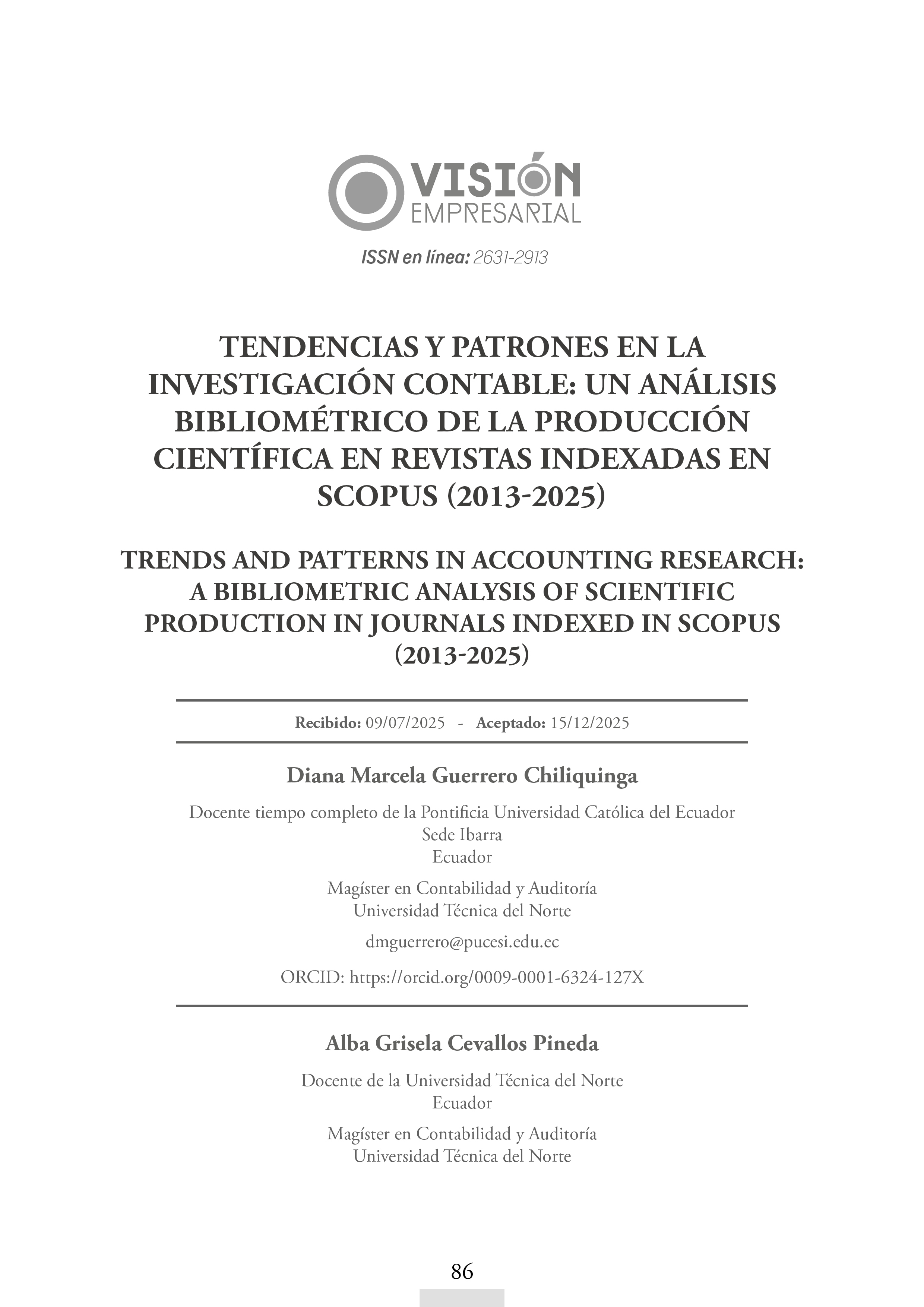
This study analyzed trends and patterns in accounting research through a bibliometric analysis of scientific production indexed in Scopus between 2013 and 2024, with the aim of identifying thematic evolution, academic collaborations, and publication impact. The methodology followed a descriptive quantitative approach, using bibliometric indicators such as annual productivity, citations, co-authorship networks, and keyword co-occurrence, processed with tools such as Bibliometrix and VOSviewer. The results revealed uneven growth in production, with China as the main contributor (40% of articles) and a significant increase in international collaborations (27,78%). Artificial intelligence emerged as a central focus (21% of studies), especially in applications such as machine learning (5%) and predictive analytics, although with low representation of ethical topics (3%). Technology journals showed greater influence (h-index = 8), while the average impact per article was 21,49 citations per document, indicating a shift toward more specialized research. It was concluded that accounting is undergoing an irreversible digital transformation, where the integration of advanced technologies is redefining traditional practices, but challenges persist in governance and geographic equity in scientific production. These findings highlight the need to strengthen interdisciplinary approaches and ethical frameworks to guide the future of accounting research.
Downloads
References
Almeida-Blacio, J. H., Naranjo-Armijo, F. G., Maldonado-Pazmiño, H. O., & Rodríguez-Lara, A. D. (2024). Inteligencia artificial como mecanismo eficiente de la contabilidad [Article]. Código Científico Revista de Investigación, 5(E3), 334–364. https://doi.org/https://doi.org/10.55813/gaea/ccri/v5/nE3/320
Amin, H. M. G., Hassan, R. S., Ghoneim, H., & Abdallah, A. S. (2025). A bibliometric analysis of accounting education literature in the digital era: current status, implications and agenda for future research. Journal of Financial Reporting and Accounting, 23(2), 742–768. https://doi.org/https://doi.org/10.1108/JFRA-12-2023-0802
Aria, M., & Cuccurullo, C. (2017). bibliometrix: An R-tool for comprehensive science mapping analysis. Journal of Informetrics, 11(4), 959–975. https://doi.org/https://doi.org/10.1016/j.joi.2017.08.007
Bibliometrix. (2024, November 4). Scopus Preview. Scopus.com/freelookup/form/author.uri?zone=TopNavBar&origin=NO%20ORIGIN%20DEFINED
Brabete, V., Sichigea, M., Cîrciumaru, D., & Goagără, D. (2024). Bibliometric Mapping of the Relationships Between Accounting, Professional Accountants, and Sustainability Issues. Sustainability (2071-1050), 16(21). https://doi.org/https://doi.org/10.3390/su16219508
Caicedo-Basurto, R. L. (2023). Análisis bibliográfico sobre la evolución y las tendencias recientes en la contabilidad financiera. Innova Science Journal, 1(1), 51–63. https://doi.org/https://orcid.org/0009-0001-0873-4338
Calò, L. N. (2022). Métricas de impacto y evaluación de la ciencia. Revista Peruana de Medicina Experimental y Salud Pública, 39, 236–240. https://doi.org/https://doi.org/10.17843/rpmesp.2022.392.11171
Castro-Alfaro, A., & Solar-Vega, L. (2024). La bibliometría como herramienta esencial en la investigación científica: explorando su importancia y aplicaciones. INNOVA-LUZ, 1(2), 31–37. https://innova-luz.com/index.php/revista/article/view/17
Chiu, V., Liu, Q., Muehlmann, B., & Baldwin, A. A. (2019). A bibliometric analysis of accounting information systems journals and their emerging technologies contributions. International Journal of Accounting Information Systems, 32, 24–43. https://doi.org/10.1016/J.ACCINF.2018.11.003
Donthu, N., Kumar, S., Mukherjee, D., Pandey, N., & Lim, W. M. (2021). How to conduct a bibliometric analysis: An overview and guidelines. Journal of Business Research, 133, 285–296.
Egghe, L. (1986). The dual of Bradford’s law. Journal of the American Society for Information Science, 37(4), 246–255.
Elo, T., Pätäri, S., Sjögrén, H., & Mättö, M. (2024). Transformation of skills in the accounting field: the expectation–performance gap perceived by accounting students. Accounting Education, 33(3), 237–273. https://doi.org/https://doi.org/10.1080/09639284.2023.2191289
Fisch, C., & Block, J. (2018). Six tips for your (systematic) literature review in business and management research. Management Review Quarterly, 68, 103–106. https://doi.org/https://doi.org/10.1007/s11301-018-0142-x
Göktürk, I. E., Güvemli, B., & Sarısy, Ö. (2024). Exploring Journal of Emerging Technologies in Accounting: A Content and Citation Analysis of JETA. Journal of Emerging Technologies in Accounting, 21(1), 29–41. https://doi.org/10.2308/JETA-2023-015
Gonçalves, M. J. A., da Silva, A. C. F., & Ferreira, C. G. (2022). The future of accounting: how will digital transformation impact the sector? Informatics, 9(1), 19. https://doi.org/https://doi.org/10.3390/informatics9010019
Guthrie, J., & Parker, L. D. (2016). Whither the accounting profession, accountants and accounting researchers? Commentary and projections. Accounting, Auditing & Accountability Journal, 29(1), 2–10. https://doi.org/https://doi.org/10.1108/AAAJ-10-2015-2263
Juca Maldonado, F., Carchi Arias, K. L., & Rosales Muñoz, C. (2024). Transformación Contable: El impacto de la inteligencia artificial en la eficiencia de los procesos de análisis de costos. Revista Científica Sapientia Technological, 50–60. https://doi.org/https://doi.org/10.58515/edesp1spt05
Leitner-Hanetseder, S., Lehner, O. M., Eisl, C., & Forstenlechner, C. (2021). A profession in transition: actors, tasks and roles in AI-based accounting. Journal of Applied Accounting Research, 22(3), 539–556. https://doi.org/10.1108/JAAR-10-2020-0201
Lukka, K., & Modell, S. (2010). Validation in interpretive management accounting research. Accounting, Organizations and Society, 35(4), 462–477. https://doi.org/https://doi.org/10.1016/j.aos.2009.10.004
Lupton, R. C., & Allwood, J. M. (2017). Hybrid Sankey diagrams: Visual analysis of multidimensional data for understanding resource use. Resources, Conservation and Recycling, 124, 141–151. https://doi.org/http://dx.doi.org/10.1016/j.resconrec.2017.05.002
McKinney Jr, E., Yoos II, C. J., & Snead, K. (2017). The need for ‘skeptical’accountants in the era of Big Data. Journal of Accounting Education, 38, 63–80.
Melega, A. (2022). Bibliometric analysis of scientific production regarding the harmonization of accounting in BRICS emerging economies. European Journal of Accounting, Finance & Business, 10(1), 11–20. https://doi.org/10.4316/EJAFB.2022.1012
Merigó, J., Blanco‐Mesa, F., Gil‐Lafuente, A., & Yager, R. (2017). Thirty years of the International Journal of Intelligent Systems: A bibliometric review. International Journal of Intelligent Systems, 32(5), 526–554. https://doi.org/https://doi.org/10.1002/int.21859
Merigó, J., & Yang, J.-B. (2017). A bibliometric analysis of operations research and management science. Omega, 73, 37–48. https://doi.org/https://doi.org/10.1016/j.omega.2016.12.004
Mohammad, S. J., Hamad, A. K., Borgi, H., Thu, P. A., Sial, M. S., & Alhadidi, A. A. (2020). How artificial intelligence changes the future of accounting industry. International Journal of Economics and Business Administration, 8(3), 478–488.
Mongeon, P., & Paul-Hus, A. (2016). The journal coverage of Web of Science and Scopus: a comparative analysis. Scientometrics, 106, 213–228. https://doi.org/doi:https://doi.org/10.1007/s11192-015-1765-5
Page, M., McKenzie, J., Bossuyt, P., Boutron, I., Hoffmann, T., Mulrow, C., Shamseer, L., Tetzlaff, J., Akl, E. A., & Brennan, S. E. (2021). Declaración PRISMA 2020: una guía actualizada para la publicación de revisiones sistemáticas. Revista Española de Cardiología, 74(9), 790–799. https://doi.org/https://doi.org/10.1016/j.recesp.2021.06.016
Podsakoff, P. M., MacKenzie, S. B., Podsakoff, N. P., & Bachrach, D. G. (2008). Scholarly influence in the field of management: A bibliometric analysis of the determinants of university and author impact in the management literature in the past quarter century. Journal of Management, 34(4), 641–720. https://doi.org/https://doi.org/10.1177/0149206308319533
Quispe, G., Arellano, O., & Duchi, T. (2024). Estudio de modelos contables y su evolución en las empresas. Un estudio bibliométrico. Esprint Investigación, ISSN-e 2960-8317, Vol. 3, No. Extra 3, 2024 (Ejemplar Dedicado a: Accounting and Auditing: Advances and Perspectives (Special Edition)), Págs. 16-28, 3(3), 16–28. https://doi.org/https://doi.org/10.61347/ei.v3i3.78
Rawashdeh, A. (2025). The consequences of artificial intelligence: an investigation into the impact of AI on job displacement in accounting. Journal of Science and Technology Policy Management, 16(3), 506–535. https://doi.org/https://doi.org/10.1108/JSTPM-02-2023-0030
Rodrigues, M., do Céu Alves, M., Oliveira, C., Vale, V., Vale, J., & Silva, R. (2021). Dissemination of social accounting information: A bibliometric review. Economies, 9(1), 41. https://doi.org/https://doi.org/10.3390/economies9010041
Salgado, J. (2024). Impacto de la inteligencia artificial en la práctica contable. Revista Facultad de Ciencias Económicas, 32(1), 7–11. https://doi.org/https://doi.org/10.18359/rfce.7472
Sangadji, S. S. (2023). Foundations of bibliometric writing: A comprehensive guide for novice researchers. SCIENTIA: Journal of Multi Disciplinary Science, 2(2), 95–107.
Shoeb, M., Aslam, A., & Aslam, A. (2022). Environmental accounting disclosure practices: A bibliometric and systematic review. International Journal of Energy Economics and Policy, 12(4), 226–239. https://doi.org/10.32479/ijeep.13085.
Tavares, M., Azevedo, G., Marques, R., & Bastos, M. (2023). Challenges of education in the accounting profession in the Era 5.0: A systematic review. Cogent Business & Management, 10(2), 2220198. https://doi.org/https://doi.org/10.1080/23311975.2023.2220198
Vărzaru, A. A. (2022). Assessing artificial intelligence technology acceptance in managerial accounting. Electronics, 11(14), 2256.
Zupic, I., & Čater, T. (2015). Bibliometric methods in management and organization. Organizational Research Methods, 18(3), 429–472. https://doi.org/https://doi.org/10.1177/1094428114562629
Downloads
Published
Issue
Section
License
Copyright (c) 2026 Diana Marcela Guerrero Chiliquinga , Alba Grisela Cevallos-Pineda

This work is licensed under a Creative Commons Attribution-NonCommercial-ShareAlike 4.0 International License.
El autor mantiene los derechos morales e intelectuales de su obra, autorizando a la editorial de la revista Visión Empresarial la difusión y divulgación de su contenido con fines estrictamente académicos y de investigación, sin fines de lucro.