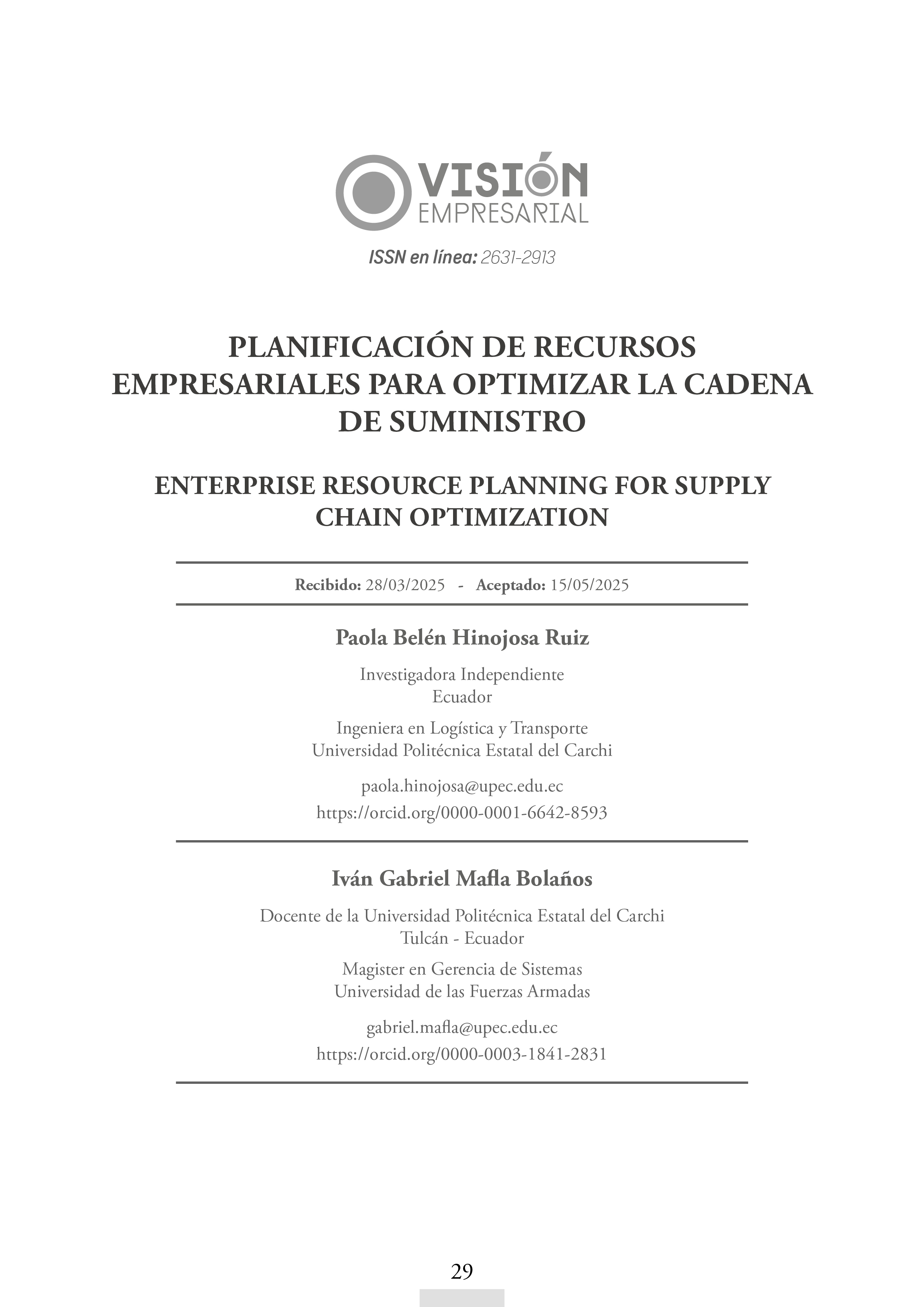
Enterprise Resource Planning for Supply Chain Optimization
DOI:
https://doi.org/10.32645/13906852.1463Keywords:
Enterprise Resource Planning , ERP, supply chain optimization, process automation, COBIT 5, Industry 4.0Abstract
This paper proposes an Enterprise Resource Planning (ERP) system model for optimizing the supply chain at Grupo Vásquez Pharmaceutical Distributor, aiming to increase operational efficiency, reduce costs, and improve customer satisfaction. A quantitative approach was used, applying the COBIT 5 framework to assess the maturity level of supply chain management processes before and after ERP implementation. Key indicators such as delivery times, process automation, delivery accuracy, and operational costs were analyzed. The main results indicate that process automation led to significant improvements in delivery times (reduction from 7 to 2 days for high-rotation products) and delivery accuracy (error rate reduced from 15% to 3%). Additionally, automation reduced monthly operational costs by 30%. The findings suggest that the integration of Odoo not only optimized the supply chain but also positioned the company to meet the demands of Industry 4.0. The paper concludes that ERP implementation had a positive impact on the distributor’s competitiveness and long-term sustainability.
Downloads
References
Acevedo Avila, L. A., Acuña Jimenes, M. R., Bazán Ríos, A. J., Grijalba Atavios, E. E., Guarderas Rodriguez, M. E., Huailla Chaupe, C. A., y Lazaro Saavedra, D. P. (2022). La implementación de un sistema ERP en las PYMES de manufactura. Gestión De Operaciones Industriales, 1(1), 61-72. https://revistas.unitru.edu.pe/index.php/RINGIND/article/view/4450
Chirvase, C.S., y Zamfir, A. (2023). Explorando el desarrollo de la planificación de recursos empresariales (ERP): Desafíos, oportunidades y cómo puede ayudar a las empresas a navegar en tiempos contemporáneos turbulentos. En Actas de la Conferencia Internacional sobre Excelencia Empresarial, (17)1 1919-1928. https://doi.org/10.2478/picbe-2023-0169 https://sciendo.com/article/10.2478/picbe-2023-0169
COBIT 5. (2012). COBIT 5: A business framework for the governance and management of enterprise IT. ISACA.
Gruchmann, T., Elgazzar, S., & Ali, A. H. (2023). Blockchain technology in pharmaceutical supply chains: a transaction cost perspective. Modern Supply Chain Research and Applications, 5(2), 115–133. https://doi.org/10.1108/MSCRA-10-2022-0023
Hohenstein, N., Feisel, E., & Hartmann, E. (2021). The impact of Industry 4.0 on Supply Chain Management. International Journal of Operations & Production Management, 41(4), 350-369. https://urn.fi/URN:NBN:fi:amk-2021121325601
Hupman, A. C., Zhang, J., & Li, H. (2024). Predicting pharmaceutical supply chain disruptions before and during the COVID-19 pandemic. Risk Analysis, 44(12), 2797–2811. https://doi.org/10.1111/risa.17453
ISACA. (2020). COBIT 5: A Business Framework for the Governance and Management of Enterprise IT. ISACA.
Lee, C., Kim, H. F., & Lee, B. G. (2024). A systematic literature review on the strategic shift to Cloud ERP: Leveraging microservice architecture and MSPs for resilience and agility. Electronics, 13(14), 2885. https://doi.org/10.3390/electronics13142885
Parada, J., y Parra, C. (2022). Análisis del uso de plataformas tecnológicas tipo (ERP) en los procesos de la cadena de suministro (compras y contratación) en proyectos de construcción, en comparación con el modelo tradicional. Caso de estudio empresa Proinark S.A. [Tesis de grado, Universidad Católica de Colombia]. RIUCaC. https://hdl.handle.net/10983/26966
Pedroso, S., Lopes, I., Pavón, Y., y Blanco, J. (2022). Despliegue del sistema ERP Odoo en un Laboratorio experimental de producción. Revista Cubana de Transformación Digital, 3(4), e195. https://rctd.uic.cu/rctd/article/view/195/10
Pérez, J. (2020). Impacto de la implementación del ERP Odoo en la productividad de la empresa “Tuki Consultoría y Tecnología” en la ciudad de Cajamarca, 2019 [Tesis de grado, Universidad Privada del Norte]. Repositorio Institucional UPN. https://hdl.handle.net/11537/23944
Ramírez, C. (2021). Evolución de la gestión de la cadena de suministro y la logística, desde una visión tecnológica y sostenible. Reto, 8(1), 22-31. https://doi.org/10.23850/reto.v8i1.2863 https://revistas.sena.edu.co/index.php/RETO/article/view/2863
Sastre, P. (2020). Desarrollo de una aplicación para Odoo ERP [Tesis de grado, Universidad Politécnica de València]. RiuNet Repositorio UPV. https://riunet.upv.es/handle/10251/151984
Schwab, K. (2020). The fourth industrial revolution. Crown Publishing Group.
Zhu, X., Ninh, A., Zhao, H., & Liu, Z. (2021). Demand forecasting with supply-chain information and machine learning: Evidence in the pharmaceutical industry. Production and Operations Management, 30(9), 3231–3252. https://doi.org/10.1111/poms.13426
Downloads
Published
Issue
Section
License
Copyright (c) 2026 Paola Belén Hinojosa Ruiz , Iván Gabriel Mafla Bolaños

This work is licensed under a Creative Commons Attribution-NonCommercial-ShareAlike 4.0 International License.
El autor mantiene los derechos morales e intelectuales de su obra, autorizando a la editorial de la revista Visión Empresarial la difusión y divulgación de su contenido con fines estrictamente académicos y de investigación, sin fines de lucro.