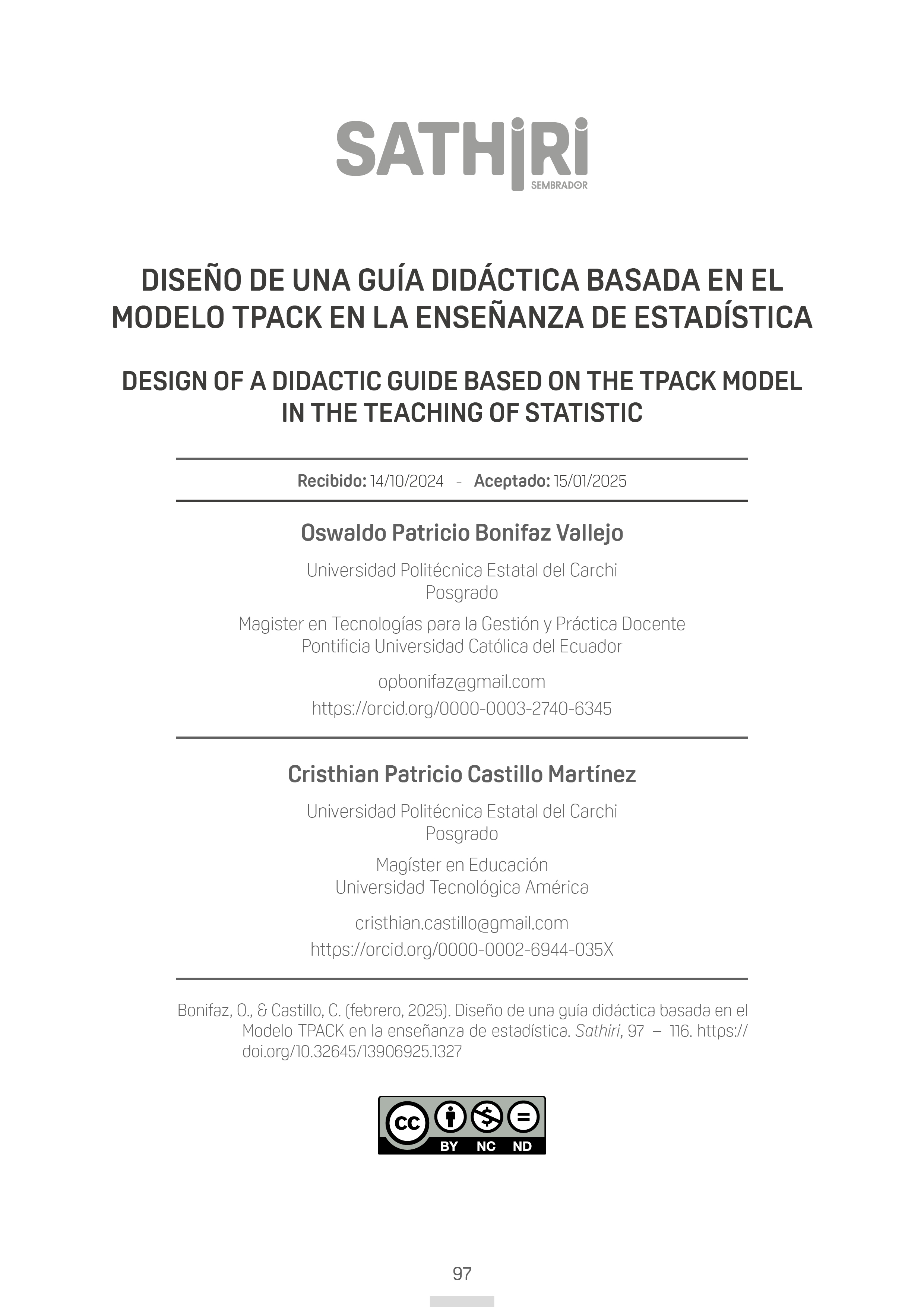
Diseño de una guía didáctica basada en el Modelo TPACK en la enseñanza de estadística
DOI:
https://doi.org/10.32645/13906925.1355Palabras clave:
Modelo TPACK, Tecnologías, Educación, EstadísticaResumen
En el mundo existen varios enfoques y corrientes pedagógicas que se adaptan o cambian a los contextos actuales en respuesta a la evolución sociocultural, avances tecnológicos y a las necesidades regionales, propias de la comunidad educativa. La presente investigación exploratoria se realizó bajo un enfoque mixto y su objetivo fue diseñar una guía didáctica basada en el Modelo TPACK (Conocimiento Tecnológico, Pedagógico y del Contenido), que identifica los conocimientos necesarios que deben tener los docentes, a fin de mejorar el proceso de enseñanza aprendizaje, mediante la adecuada integración de tecnologías para la enseñanza de la materia de Estadística. La investigación se realizó en una institución de educación superior de la Amazonía ecuatoriana. Dentro del proceso estadístico de validación de resultados de los 151 estudiantes encuestados, se obtuvo un coeficiente de 0.89 del Alpha de Cronbach de las 36 variables en estudio. También se realizó el cálculo de la matriz de correlaciones, lo cual permitió determinar que no existe presencia de variables redundantes y evidenció la necesidad de fortalecer las competencias digitales de los docentes de Estadística, específicamente en el manejo de software especializado y la integración efectiva de tecnologías en las clases. La aplicación de una guía didáctica basada en el modelo TPACK, diseñada como respuesta a los requerimientos identificados, representa una solución viable para mejorar el proceso de enseñanza aprendizaje de la Estadística en la institución objeto del estudio. Al combinar conocimientos tecnológicos, pedagógicos y de contenido, esta guía busca potenciar el uso de herramientas digitales y técnicas pedagógicas efectivas en la impartición de esta materia.
Descargas
Referencias
Angeli, C., & Valanides, N. (2009). Epistemological and methodological issues for the conceptualization, development, and assessment of ICT-TPCK: Advances in technological pedagogical content knowledge (TPCK). Computers and Education, 52(1), 154-168. https://doi.org/10.1016/j.compedu.2008.07.006 DOI: https://doi.org/10.1016/j.compedu.2008.07.006
Archambault, L. M., & Barnett, J. H. (2010). Revisiting technological pedagogical content knowledge: Exploring the TPACK framework. Computers and Education, 55(4), 1656-1662. https://doi.org/10.1016/j.compedu.2010.07.009 DOI: https://doi.org/10.1016/j.compedu.2010.07.009
Banas, J. R. (2010). Teachers’ attitudes toward technology: Considerations for designing preservice and practicing teacher instruction. Community and Junior College Libraries, 16(2), 114-127. https://doi.org/10.1080/02763911003707552 DOI: https://doi.org/10.1080/02763911003707552
Baran, E., Canbazoglu Bilici, S., Albayrak Sari, A., & Tondeur, J. (2019). Investigating the impact of teacher education strategies on preservice teachers’ TPACK. British Journal of Educational Technology, 50(1), 357-370. https://doi.org/10.1111/bjet.12565 DOI: https://doi.org/10.1111/bjet.12565
Barragán, S. R. (2013). SOCIAL AND EDUCATIONAL CHANGES USING ICT: U-LEARNING AND U-PORTFOLIO. Revista Electrónica de Investigación y Docencia, 7-20. http://www.revistareid.net/revista/n10/REID10art1.pdf
Bartletf, M. S. (1954). A NOTE ON THE MULTIPLYING FACTORS FOR VARIOUS X 2 ApPROXIMATIONS. DOI: https://doi.org/10.1111/j.2517-6161.1954.tb00174.x
Chai, C. S., Hwee Ling Koh, J., & Teo, Y. H. (2019). Enhancing and Modeling Teachers’ Design Beliefs and Efficacy of Technological Pedagogical Content Knowledge for 21st Century Quality Learning. Journal of Educational Computing Research, 57(2), 360-384. https://doi.org/10.1177/0735633117752453 DOI: https://doi.org/10.1177/0735633117752453
Chugh, R., & Ruhi, U. (2018). Social media in higher education: A literature review of Facebook. Education and Information Technologies, 23(2), 605-616. https://doi.org/10.1007/s10639-017-9621-2 DOI: https://doi.org/10.1007/s10639-017-9621-2
Creswell, J. W., & Poth, C. N. (2017). Designing and Conducting MIXED METHODS RESEARCH (H. salmon, Ed.; 3.a ed.).
García, A. V., & Rodríguez, J. C. (2023). Características de la Enseñanza Eficaz en Educación Superior: modalidad presencial vs virtual. Revista de Estudios y Experiencias en Educación, 22(49), 50-68. https://doi.org/10.21703/rexe.v22i49.1540 DOI: https://doi.org/10.21703/rexe.v22i49.1540
Garfield, J. B., & Ben-Zvi, D. (2008). Developing Students’ Statistical Reasoning. Springer Science+Business Media B.V.
Gómez, V., Matarranz, M., Casado, L. A., & Otto, A. (2022). Teachers’ digital competencies in higher education: a systematic literature review. International Journal of Educational Technology in Higher Education, 19(1). https://doi.org/10.1186/s41239-021-00312-8 DOI: https://doi.org/10.1186/s41239-021-00312-8
Grundmann, S. ;, Stilz, M. ;, & Becker. (2019). Digitale Welten-Unterricht 4.0 in der beruflichen Fachrichtung Ernährung und Hauswirtschaft. Haushalt in Bildung & Forschung, 8, 26-41. https://doi.org/10.25656/01:23231 DOI: https://doi.org/10.3224/hibifo.v8i3.03
Guerrero, O., Lara, Í., & Barahona, J. (2024). Formato ficha_Validación de instrumentos_UPEQ.
Harris, J., Phillips, M., Koehler, M., & Rosenberg, J. (2017). Editorial: Volume 33 Issue 3 TPCK/TPACK research and development: Past, present, and future directions. Australasian Journal of Educational Technology, 3, 33. http://activitytypes.wm.edu/TPACKNewsletters/index.html DOI: https://doi.org/10.14742/ajet.3907
Hashimov, E. (2015). Qualitative Data Analysis: A Methods Sourcebook and The Coding Manual for Qualitative Researchers. Technical Communication Quarterly, 24(1), 109-112. https://doi.org/10.1080/10572252.2015.975966 DOI: https://doi.org/10.1080/10572252.2015.975966
Herrington, J., Parker, J., & Boase-Jelinek, D. (2014). Connected authentic learning: Reflection and intentional learning. Australian Journal of Education, 58(1), 23-35. https://doi.org/10.1177/0004944113517830 DOI: https://doi.org/10.1177/0004944113517830
Huang, L., Li, S., Poitras, E. G., & Lajoie, S. P. (2021). Latent profiles of self-regulated learning and their impacts on teachers’ technology integration. British Journal of Educational Technology, 52(2), 695-713. https://doi.org/10.1111/bjet.13050 DOI: https://doi.org/10.1111/bjet.13050
Irwanto, I. (2021). Research trends in technological pedagogical content knowledge (TPACK): A systematic literature review from 2010 to 2021. European Journal of Educational Research, 10(4), 2045-2054. https://doi.org/10.12973/EU-JER.10.4.2045 DOI: https://doi.org/10.12973/eu-jer.10.4.2045
Islas Torres, C. (2018). The role of TIC in education: Applications, Limitations, and Future Trends. RIDE Revista Iberoamericana para la Investigación y el Desarrollo Educativo, 8(15), 861-876. https://doi.org/10.23913/ride.v8i15.324 DOI: https://doi.org/10.23913/ride.v8i15.324
IST_TENA. (2023). Informe autoevaluación IST TENA 2023.
Jiménez, R., & Alvarado, J. (2017). VALIDACIÓN DE UN CUESTIONARIO DISEÑADO PARA MEDIR FRECUENCIA Y AMPLITUD DE USO DE LAS TIC. Revista Electrónica de Tecnología Educativa, 61. DOI: https://doi.org/10.21556/edutec.2017.61.949
Kaiser, H. F. (1974). AN INDEX OF FACTORIAL SIMPLICITY*. UNITED STATES COAST GUARD ACADEMY, 39. https://doi.org/10.1007/bf02291575 DOI: https://doi.org/10.1007/BF02291575
Kholid, M. N., Hendriyanto, A., Sahara, S., Muhaimin, L. H., Juandi, D., Sujadi, I., Kuncoro, K. S., & Adnan, M. (2023). A systematic literature review of Technological, Pedagogical and Content Knowledge (TPACK) in mathematics education: Future challenges for educational practice and research. Cogent Education, 10(2). https://doi.org/10.1080/2331186X.2023.2269047 DOI: https://doi.org/10.1080/2331186X.2023.2269047
Koehler, M. J., Mishra, P., Kereluik, K., Shin, T. S., & Graham, C. R. (2014). The technological pedagogical content knowledge framework. En Handbook of Research on Educational Communications and Technology: Fourth Edition (pp. 101-111). Springer New York. https://doi.org/10.1007/978-1-4614-3185-5_9 DOI: https://doi.org/10.1007/978-1-4614-3185-5_9
Koehler, M. J., Mishra, P., & Rosenberg, J. (2013). The Technological Pedagogical Content Knowledge Framework for Teachers and Teacher Educators. ResearcheGate. https://doi.org/0EW7-01WB-BKHL-QDYV
Kramarski, B., & Michalsky, T. (2010). Preparing preservice teachers for self-regulated learning in the context of technological pedagogical content knowledge. Learning and Instruction, 20(5), 434-447. https://doi.org/10.1016/j.learninstruc.2009.05.003 DOI: https://doi.org/10.1016/j.learninstruc.2009.05.003
Manca, S., & Ranieri, M. (2016). Facebook and the others. Potentials and obstacles of Social Media for teaching in higher education. Computers and Education, 95, 216-230. https://doi.org/10.1016/j.compedu.2016.01.012 DOI: https://doi.org/10.1016/j.compedu.2016.01.012
Martínez, P., Yot-Domínguez, C., & Marcelo, C. (2023). Teachers and social networks: uses and motivation. Revista de Educación a Distancia, 23(72). https://doi.org/10.6018/red.523561 DOI: https://doi.org/10.6018/red.523561
Medina, E. J., Muñiz, J. L., Guzmán, D. S., & Holguín, A. (2022). Resources and strategies for teaching statistics and data analytics in higher education. Formacion Universitaria, 15(3), 61-68. https://doi.org/10.4067/S0718-50062022000300061 DOI: https://doi.org/10.4067/S0718-50062022000300061
Meissner, H. I., Creswell, J. W., Klassen, A. C., Clark, V. L. P., & Smith, K. C. (2011). Best Practices for Mixed Methods Research in the Health Sciences. DOI: https://doi.org/10.1037/e566732013-001
Mishra, P., & Koehler, M. (2006). Technological Pedagogical Content Knowledge: A Framework for Teacher Knowledge PUNYA MISHRA. Teachers College Record, 108(6), 1017-1054. https://is.gd/15lZvT DOI: https://doi.org/10.1177/016146810610800610
Moreno, J. R., Montoro, M. A., & Colón, A. M. O. (2019). Changes in teacher training within the TPACK model framework: A systematic review. Sustainability (Switzerland), 11(7). https://doi.org/10.3390/su11071870 DOI: https://doi.org/10.3390/su11071870
Munyengabe, S., Yiyi, Z., Haiyan, H., & Hitimana, S. (2017). Primary teachers’ perceptions on ICT integration for enhancing teaching and learning through the implementation of one Laptop Per Child program in primary schools of Rwanda. Eurasia Journal of Mathematics, Science and Technology Education, 13(11), 7193-7204. https://doi.org/10.12973/ejmste/79044 DOI: https://doi.org/10.12973/ejmste/79044
Ning, Y., Zhou, Y., Wijaya, T. T., & Chen, J. (2022). Teacher Education Interventions on Teacher TPACK: A Meta-Analysis Study. En Sustainability (Switzerland) (Vol. 14, Número 18). MDPI. https://doi.org/10.3390/su141811791 DOI: https://doi.org/10.3390/su141811791
Paidican, M., & Arredondo, P. (2022). Evaluación de la validez y fiabilidad del cuestionario de conocimiento tecnológico pedagógico del contenido (TPACK) para docentes de primaria. Revista Innova Educación, 5(1), 38-58. https://doi.org/10.35622/j.rie.2023.05.003 DOI: https://doi.org/10.35622/j.rie.2023.05.003
Paidicán, M., & Arredondo, P. A. (2023). Conocimiento técnico pedagógico del contenido (TPACK) en Iberoamérica: Una revisión bibliográfica. Revista Andina de Educación, 6(2), 000629. https://doi.org/10.32719/26312816.2022.6.2.9 DOI: https://doi.org/10.32719/26312816.2022.6.2.9
Ponce, J., Cervantes, D., & Robles, A. (2021). ¿Qué tan apropiadamente reportaron los autores el Coeficiente del Alfa de Cronbach? Ciencia Latina Revista Científica Multidisciplinar, 5(3), 2438-2462. https://doi.org/10.37811/cl_rcm.v5i3.463 DOI: https://doi.org/10.37811/cl_rcm.v5i3.463
Rahman, A., Santosa, T., Sofianora, A., Oktavianti, F., Alawiyah, R., Putra, R., & Alawiyah, R. (2023). International Journal of Education and Literature (IJEL) Systematic Literature Review: TPACK-Integrated Design Thinking in Education. International Journal of Education and Literature (IJEL), 2, 1-13. https://ijel.amikveteran.ac.id/index.php/ijel/index DOI: https://doi.org/10.55606/ijel.v2i1.57
Rosenberg, J. M., & Koehler, M. J. (2015). Context and technological pedagogical content knowledge (TPACK): A systematic review. Journal of Research on Technology in Education, 47(3), 186-210. https://doi.org/10.1080/15391523.2015.1052663 DOI: https://doi.org/10.1080/15391523.2015.1052663
Rujas, J., & Feito, R. (2021). La educación en tiempos de pandemia: una situación excepcional y cambiante. Revista de Sociología de la Educación-RASE, 14(1), 4. https://doi.org/10.7203/rase.14.1.20273 DOI: https://doi.org/10.7203/RASE.14.1.20273
Schmidt, D. A., Baran, E., Thompson, A. D., Mishra, P., Koehler, M. J., & Shin, T. S. (2009). Technological pedagogical content knowledge (Track): The development and validation of an assessment instrument for preservice teachers. Journal of Research on Technology in Education, 42(2), 123-149. https://doi.org/10.1080/15391523.2009.10782544 DOI: https://doi.org/10.1080/15391523.2009.10782544
Shulman, L. S. (1986). Those Who Understand: Knowledge Growth in Teaching. https://doi.org/10.3102/0013189x015002004 DOI: https://doi.org/10.2307/1175860
Siemens, G. (2005). Learning theory for the digital age. International Journal of Instructional Technology and Distance Learning.
Streiner, D. L. (2003). Starting at the beginning: An introduction to coefficient alpha and internal consistency. Journal of Personality Assessment, 80(1), 99-103. https://doi.org/10.1207/S15327752JPA8001_18 DOI: https://doi.org/10.1207/S15327752JPA8001_18
Su, J. (2023). Preservice teachers’ technological pedagogical content knowledge development: A bibliometric review. En Frontiers in Education (Vol. 7). Frontiers Media S.A. https://doi.org/10.3389/feduc.2022.1033895 DOI: https://doi.org/10.3389/feduc.2022.1033895
Suárez, M. (2000). Las corrientes pedagógicas contemporáneas y sus implicaciones en las tareas del docente y en el desarrollo curricular.
Tarnoki, C., & Puentes, K. (2019). Something for everyone: A review of qualitative inquiry and research design: Choosing among five approaches. Qualitative Report, 24(12), 3122-3124. https://doi.org/10.46743/2160-3715/2019.4294 DOI: https://doi.org/10.46743/2160-3715/2019.4294
Teddlie, C., & Tashakkori, A. (2012). Common «Core» Characteristics of Mixed Methods Research: A Review of Critical Issues and Call for Greater Convergence. American Behavioral Scientist, 56(6), 774-788. https://doi.org/10.1177/0002764211433795 DOI: https://doi.org/10.1177/0002764211433795
Torggler, C., Miesera, S., & Nerdel, C. (2023). From TPACK to N-TPACK Framework for Vocational Education and Training With a Focus on Nutritional Science and Home Economics. International Journal for Research in Vocational Education and Training, 10(2), 168-190. https://doi.org/10.13152/IJRVET.10.2.2 DOI: https://doi.org/10.13152/IJRVET.10.2.2
Vives, T., & Hamui, L. (2021). La codificación y categorización en la teoría fundamentada, un método para el análisis de los datos cualitativos. Investigación en Educación Médica, 40, 97-104. https://doi.org/10.22201/fm.20075057e.2021.40.21367 DOI: https://doi.org/10.22201/fm.20075057e.2021.40.21367
Voogt, J., Fisser, P., Pareja Roblin, N., Tondeur, J., & van Braak, J. (2013). Technological pedagogical content knowledge - A review of the literature. Journal of Computer Assisted Learning, 29(2), 109-121. https://doi.org/10.1111/j.1365-2729.2012.00487.x DOI: https://doi.org/10.1111/j.1365-2729.2012.00487.x
Yeh, Y. F., Chan, K. K. H., & Hsu, Y. S. (2021). Toward a framework that connects individual TPACK and collective TPACK: A systematic review of TPACK studies investigating teacher collaborative discourse in the learning by design process. Computers and Education, 171. https://doi.org/10.1016/j.compedu.2021.104238 DOI: https://doi.org/10.1016/j.compedu.2021.104238
Zawacki-Richter, O., Marín, V. I., Bond, M., & Gouverneur, F. (2019). Systematic review of research on artificial intelligence applications in higher education – where are the educators? International Journal of Educational Technology in Higher Education, 16(1). https://doi.org/10.1186/s41239-019-0171-0 DOI: https://doi.org/10.1186/s41239-019-0171-0
Publicado
Número
Sección
Licencia
Derechos de autor 2025 Oswaldo Patricio Bonifaz Vallejo , Cristhian Patricio Castillo Martínez

Esta obra está bajo una licencia internacional Creative Commons Atribución-NoComercial-SinDerivadas 4.0.
El autor mantiene los derechos morales e intelectuales de su obra, autorizando a la editorial de la revista Sathiri la difusión y divulgación de su contenido con fines estrictamente académicos y de investigación, sin fines de lucro. Así mismo, se autoriza que la obra sea descargada y compartida con otras personas, siempre y cuando no sea alterada y se reconozca su autoria.