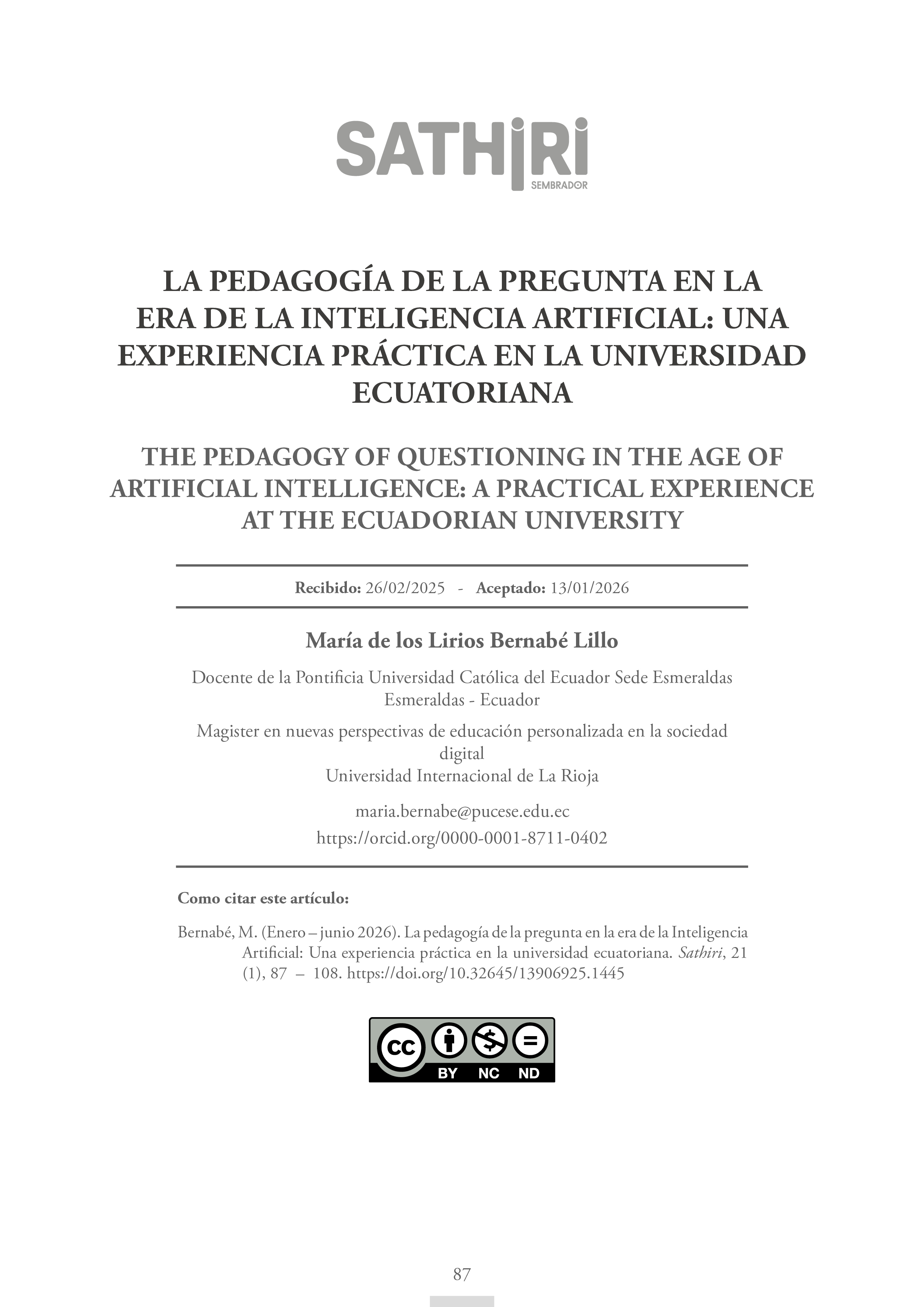
The pedagogy of questioning in the age of artificial intelligence: A practical experience at the ecuadorian university
DOI:
https://doi.org/10.32645/13906925.1445Keywords:
artificial intelligence, higher education, critical thinkingAbstract
The study analyzed the integration of generative artificial intelligence (GAI) in the course "Educational Socioanthropology and Public Policy" at the Pontifical Catholic University of Ecuador, Esmeraldas campus. Its objective was to transform the educational experience through personalized learning and the development of critical thinking, providing empirical evidence on the benefits and risks of GAI in a Latin American university context. Based on Paulo Freire's pedagogy of the question, the study aimed to foster curiosity and the formulation of meaningful questions, using GAI as a dialogical tool. A total of 24 first-year students participated, with an initial questionnaire and final interviews in order to evaluate their knowledge, use, and perception of GAI.The activities included the use of GAI to expand information, clarify concepts and encourage critical reflection. The results show that students value GAI for its personalization and depth in learning but warn of risks such as dependency and academic dishonesty. It was concluded that IAG can enhance learning if used responsibly, highlighting the key role of teachers in its ethical and effective integration into education.
Downloads
References
Chao-Rebolledo, C., & Rivera-Navarro, M. Á. (2024). Usos y percepciones de herramientas de inteligencia artificial en la educación superior en México. Revista Iberoamericana de Educación, 95(1), 57-72. https://rieoei.org/RIE/article/view/6259
Escalante, J. (2024). Actitud de los estudiantes universitarios de educación ante el uso de la inteligencia artificial. Ciencia y Sociedad: República Dominicana, 49(2), 3-17. https://dialnet.unirioja.es/servlet/articulo?codigo=9701709
Gallent-Torres, C., Zapata-González, A., & Ortego-Hernando, J. L. (2023). El impacto de la inteligencia artificial generativa en educación superior: una mirada desde la ética y la integridad académica. RELIEVE. Revista Electrónica de Investigación y Evaluación Educativa, 29(2), 1-21. https://www.redalyc.org/journal/916/91676028011/91676028011.pdf
García-Acuña, L. T., Zambrano-Andrade, F. I., Acuña-Chong, M. G., & Acuña-Cumba, M. L. (2023). Oportunidades y desafíos en la aplicación de la inteligencia artificial en la educación superior. Revista Científica Arbitrada de Investigación en Comunicación, Marketing y Empresa REICOMUNICAR. ISSN 2737-6354., 6(12 Ed. esp.), 255-282. https://www.reicomunicar.org/index.php/reicomunicar/article/view/190
González, J. L., Villota, F. R., Moscoso, A. E., Garces, S. W., & Bazurto, B. M. (2023). Aplicación de la Inteligencia Artificial en la Educación Superior. Dominio de las Ciencias, 9(3), 1097-1108. https://dominiodelasciencias.com/ojs/index.php/es/article/view/3488
Freire, P., & Faundez, A. (1985). Hacia una pedagogía de la pregunta. Siglo XXI. https://aprendizajesparalelos.wordpress.com/wp-content/uploads/2016/08/paulo-freire-y-antonio-faudez-por-una-pedagogia-de-la-pregunta.pdf
López Regalado, O., Núñez Rojas, N., López Gil, Ó. R., & Sánchez Rodríguez, J. (2024). El Análisis del uso de la inteligencia artificial en la educación universitaria: una revisión sistemática. Pixel-Bit. 70, 97-122. https://recyt.fecyt.es/index.php/pixel/article/view/106336
Luckin, R. y Holmes, W., Griffiths, M. y Forcier, L.(2016). Intelligence Unleashed: An argument for AI in Education. Pearson Education. https://www.pearson.com/content/dam/one-dot-com/one-dot-com/global/Files/about-pearson/innovation/open-ideas/IntelligenceUnleashedSPANISH.pdf
OpenAI. (2022). Training language models to follow instructions with human feedback. OpenAI Blog. https://openai.com/research/instruction-following
Perezchica-Vega, J. E., Sepúlveda-Rodríguez, J. A., & Román-Méndez, A. D. (2024). Inteligencia artificial generativa en la educación superior: usos y opiniones de los profesores. European Public & Social Innovation Review, 9, 1-20. https://epsir.net/index.php/epsir/article/view/593
Piedra-Castro, W. I., Cajamarca-Correa, M. A., Burbano-Buñay, E. S., & Moreira-Alcívar, E. F. (2024). Integración de la inteligencia artificial en la enseñanza de las Ciencias Sociales en la educación superior. Journal of Economic and Social Science Research, 4(3), 105-126. https://www.economicsocialresearch.com/index.php/home/article/view/123
Ríos, I. N., Mateus, J. C., Rivera-Rogel, D., & Ávila, L. R. (2024). Percepciones de estudiantes latinoamericanos sobre el uso de la inteligencia artificial en la educación superior. Austral Comunicacion, 13(1). https://openurl.ebsco.com/EPDB%3Agcd%3A4%3A21013508/detailv2?sid=ebsco%3Aplink%3Ascholar&id=ebsco%3Agcd%3A178367130&crl=c
Ruiz, K. K., Miramontes, M. A. & Reyna, C. (2024). Percepciones y expectativas de estudiantes universitarios sobre la IAG. European Public & Social Innovation Review, 9, 1-21. https://epsir.net/index.php/epsir/article/view/357/187
Sánchez, J. L., Villota, F. R., Moscoso, A. E., Garces, S. W., & Bazurto, B. M. (2023). Aplicación de la Inteligencia Artificial en la Educación Superior. Dominio de las Ciencias, 9(3), 1097-1108. https://dominiodelasciencias.com/ojs/index.php/es/article/view/3488
Siemens, G. (2005). Connectivism: A learning theory for the digital age. International Journal of Instructional Technology and Distance Learning, 2(1). http://itdl.org/Journal/Jan_05/article01.htm
Tejero-González, J.M. (2021). Técnicas de investigación cualitativa en los ámbitos sanitario y sociosanitario. Ediciones de la Universidad de Castilla-La Mancha. https://www.torrossa.com/it/resources/an/4943831
UNESCO (2023) Oportunidades y desafíos de la era de la IA en Educación Superior. Una introducción para los actores de la educación superior https://unesdoc.unesco.org/ark:/48223/pf0000386670_spa
UNESCO. (2023). Orientación para la IA generative en la educación y la investigación. UNESCO. https://unesdoc.unesco.org/ark:/48223/pf0000389227
Vera, F. (2023). Integración de la Inteligencia Artificial en la Educación superior: Desafíos y oportunidades. Transformar, 4(1), 17-34. https://www.revistatransformar.cl/index.php/transformar/article/view/84
Vera-Rubio, P. E., Bonilla-Gonzalez, G. P.,Quishpe-Salcán, A. C., & Campos-Yedra, H. M. (2023). La inteligencia artificial en la educación superior: un enfoque transformador. Polo del Conocimiento: Revista científico-profesional, 8(11), 67-80. https://mail.polodelconocimiento.com/ojs/index.php/es/article/view/6193
Vygotsky, L. S. (1978). Mind in Society: The Development of Higher Psychological Processes. Harvard University Press. https://www.jstor.org/stable/j.ctvjf9vz4
Wang, Y., Ou, C., & Wang, Y. (2022). Advances in prompt engineering: Future directions for human-centered AI. Proceedings of the 2022 ACM Conference on Human Factors in Computing Systems. https://doi.org/10.1145/3486568.3548669
Zamora, Y., & Mendoza, M. D. C. (2023). La Inteligencia artificial y el futuro de la educación superior: desafíos y oportunidades. Horizontes pedagógicos, 25(1), 1-13. https://horizontespedagogicos.ibero.edu.co/article/view/hop.25101
Downloads
Published
Issue
Section
License
Copyright (c) 2026 María de los Lirios Bernabé Lillo

This work is licensed under a Creative Commons Attribution-NonCommercial-NoDerivatives 4.0 International License.
El autor mantiene los derechos morales e intelectuales de su obra, autorizando a la editorial de la revista Sathiri la difusión y divulgación de su contenido con fines estrictamente académicos y de investigación, sin fines de lucro. Así mismo, se autoriza que la obra sea descargada y compartida con otras personas, siempre y cuando no sea alterada y se reconozca su autoria.