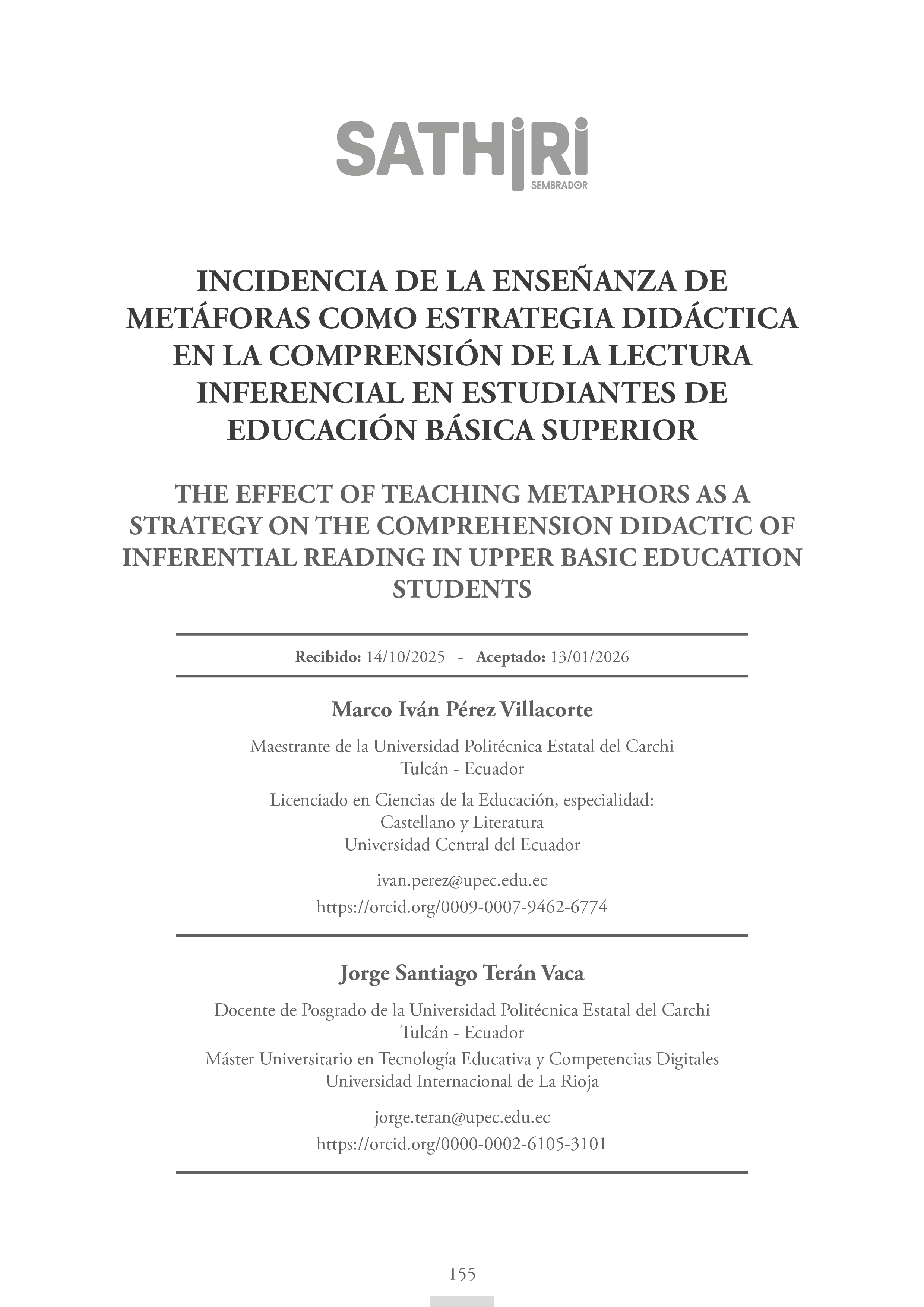
The effect of teaching metaphors as a strategy on the comprehension didactic of inferential reading in upper basic education students
DOI:
https://doi.org/10.32645/13906925.1450Keywords:
metaphors, reading comprehension, inferential reading, basic education, T-StudentAbstract
his job analyzes the impact of metaphor study on inferential reading comprehension in upper basic education students. The identified problem was the predominance of literal reading in the classroom, which limits the development of higher-order cognitive skills. The main objective was to determine the impact of the didactic use of metaphors on improving inferential reading comprehension. The research followed a quantitative approach with a quasi-experimental pretest–posttest design using a single group. The population consisted of 130 students, selected through intentional non-probabilistic sampling. The descriptive analysis of the pretest showed an average score of 5.31 (SD = 1.28), reflecting an initial medium–low level of understanding of figurative meanings. After the pedagogical intervention, the posttest reached an average of 7.84 (SD = 0.73), indicating a substantial improvement in inferential comprehension. The Shapiro–Wilk normality test confirmed the normal distribution of data, and the paired-sample T-test revealed a statistically significant difference (t = -18.45; p < 0.001). In conclusion, the study of metaphors has a positive effect on inferential comprehension by strengthening cognitive processes of interpretation and meaning transfer, promoting deeper and more critical reading.
Downloads
References
Aguila Acaro, E. (2022). La psicología evolutiva de Jean Piaget. Universidad Nacional de Educación Enrique Guzmán y Valle. https://repositorio.une.edu.pe/handle/20.500.14039/10633
Alvarracín Álvarez, et al. (2022). Aula invertida y trabajo cooperativo para promover habilidades cognitivas superiores. Actualidades Investigativas en Educación, 22(2), 257–289. https://doi.org/10.15517/aie.v22i2.48865
Arias, F. (2012). El proyecto de investigación: Introducción a la metodología científica. Editorial Episteme.
Baena Paz, G. (2018). Metodología de la información en la investigación educativa (3.ª ed.). Grupo Editorial Patria.
Boroditsky, L. (2000). Metaphoric structuring: Understanding time through spatial metaphors. Cognition, 75(1), 1–28. https://doi.org/10.1016/S0010-0277(99)00073-6
Botha, E. (2009). Why metaphor matters in education. South African Journal of Education, 29, 431–444. http://doi.org/10.15700/saje.v29n4a287
Calderón Guerrero, G. (2025). Metáforas y cognición: las relaciones parte/todo en el desarrollo infantil. Transdigital, 6(11), e414. https://doi.org/10.56162/transdigital414
Cassany, D. (1998). Enseñar lengua. Graó. https://books.google.com.ec/books?id=_kOWd3Btg4MC
Esteban Nieto, M. (2018). El nivel descriptivo en la investigación educativa. Educación y Ciencia, 21(2), 33–49.
Ferrari, M. (2006). La construcción del conocimiento en el discurso científico. Revista Signos, 39(62), 395–414.
Ferdinal, F. (2024). Bridging the worlds: Metaphor in interdisciplinary contexts. Jurnal Arbitrer, 11(2), 208–227. https://doi.org/10.25077/ar.11.2.208-227.2024
Frey, N., Fisher D., Barbee K. & Ortega S. (2025). A Model for Adolescent Reading Instruction. Education Sciencies. URL: https://www.mdpi.com/2227-7102/15/11/1442.
Hernández Sampieri, R., Fernández Collado, C., & Baptista Lucio, P. (2014). Metodología de la investigación (6.ª ed.). McGraw-Hill.
Instituto Nacional de Evaluación Educativa (INEVAL). (2025). PISA Ecuador. https://evaluaciones.evaluacion.gob.ec/pisa/
Johnson, G. L. (1980). Metáforas de la vida cotidiana. Cátedra.
Lampri, S., Peristeri, E., Marinis, T., & Andreou, M. (2024). Reading comprehension differences between children with Autism Spectrum Disorder with low cognitive abilities and children with Autism Spectrum Disorder and intact cognitive skills: The roles of decoding, fluency and morphosyntax. Frontiers in Psychology, 15, 1357590. https://doi.org/10.3389/fpsyg.2024.1357590
Martínez Godínez, V. (2013). El paradigma positivista y la investigación educativa. Revista de Educación y Sociedad, 14(28), 112–126.
McLeod, S. (2025). Piaget cognitive stages of development. Simply Psychology. https://doi.org/10.5281/zenodo.15241970
Mendoza Fillola, A. (2004). La enseñanza de la literatura como construcción de la identidad. Didáctica. Lengua y Literatura, 16, 41–61.
Munita, F. (2019). Lectura literaria y formación de lectores. Ocnos, 18(1), 7–22.
Nadalini, A., Marzi, C., Ferro, M., Cinini, A., Cutugno, P., & Chiarella, D. (2025). Inferential Reading Skills in High School: A Study on Comprehension Profiles. Education Sciences, 15(6), 654. https://doi.org/10.3390/educsci15060654
Organización para la Cooperación y el Desarrollo Económicos (OCDE). (2025). PISA 2022 Results (Volume I and II) – Country Notes: Chile. https://www.oecd.org/en/publications/pisa-2022-results-volume-i-and-ii-country-notes_ed6fbcc5-en/chile_d038b73d-en.html
Pérez Andrada, A. (2020). La metáfora como estrategia de enseñanza en el aula del siglo XXI. Revista Chilena de Pedagogía, 1(2), 26–48. https://doi.org/10.5354/2452-5855.2020.60555
Reyes M., & Plas M. (2025). Estrategias didácticas innovadoras para el fortalecimiento de procesos cognitivos implicados en la comprensión de metáforas y símbolos en textos literarios. LATAM Revista Latinoamericana de Ciencias Sociales y Humanidades, 6 (3), 60. https://doi.org/10.56712/latam.v6i3.3930
Salinas Barrios, I. (2021). Revisión de estudios sobre metáforas conceptuales en ciencia y educación científica. Pensamiento Educativo, 58(1), 1–16. https://doi.org/10.7764/pel.58.1.2021.12
Smedinga, M., Cienki, A., & Henk, W. (2023). Metaphors as tools for understanding in science communication among experts and to the public. Metaphor and the Social World, 13, 248–268. https://doi.org/10.1075/msw.22016.sme
Solé, I. (2012). Estrategias de lectura y aprendizaje. Cuadernos de Pedagogía, 216, 25–27. http://www.lecturayvida.fahce.unlp.edu.ar/numeros/a17n4/17_04_Sole.pdf
Torres, Y. (2021). Dificultades en la enseñanza de la lectura inferencial en el contexto ecuatoriano. Revista Educación y Desarrollo Social, 15(2).
Downloads
Published
Issue
Section
License
Copyright (c) 2026 Marco Iván Pérez Villacorte , Jorge Santiago Terán Vaca

This work is licensed under a Creative Commons Attribution-NonCommercial-NoDerivatives 4.0 International License.
El autor mantiene los derechos morales e intelectuales de su obra, autorizando a la editorial de la revista Sathiri la difusión y divulgación de su contenido con fines estrictamente académicos y de investigación, sin fines de lucro. Así mismo, se autoriza que la obra sea descargada y compartida con otras personas, siempre y cuando no sea alterada y se reconozca su autoria.